FHA vs. Conventional vs. VA Loans: Which Fits Your Las Vegas Home Purchase?
Quick answer: FHA loans offer flexible credit requirements and down payments starting at 3.5%, with upfront and annual mortgage insurance. Eligible conventional loans can start at 3% down, with PMI that can be canceled when requirements are met. VA loans offer eligible borrowers no down payment and no monthly mortgage insurance, but a funding fee usually applies unless exempt. Compare lender quotes for the same home price, loan term and rate-lock period.
The key distinction is who backs the loan. FHA loans are insured by the Federal Housing Administration, part of HUD. Conventional loans are not government-backed; most follow Fannie Mae or Freddie Mac rules. VA loans are guaranteed by the Department of Veterans Affairs for borrowers who meet its service requirements. Each backer sets its own rules on credit, down payment, ongoing cost and the condition of the home. If you are still building your budget, start with our breakdown of what it costs to buy a $500,000 home in Las Vegas, then come back here to compare financing.
FHA
Down payment: 3.5% with a 580+ credit score; lender requirements may be higher.
Upfront MIP: 1.75% of the base loan.
Annual MIP: Typically 0.55% for a 30-year, minimum-down-payment loan within Clark County's one-unit limit. [4]
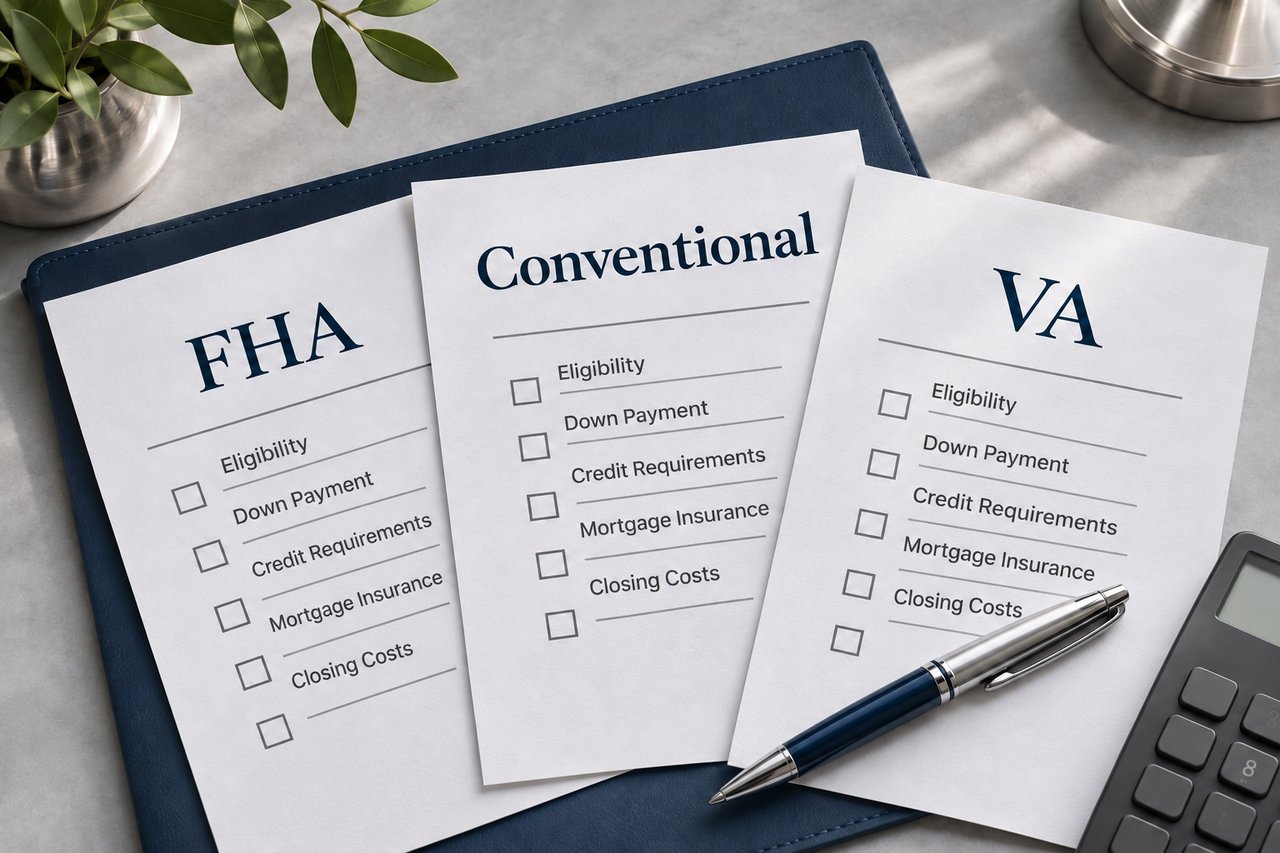
FHA vs. conventional vs. VA loans at a glance
Consideration | FHA | Conventional | VA |
|---|---|---|---|
Who can use it | U.S. citizens, lawful permanent residents and certain Compact of Free Association citizens; principal residence [3] [5] | Any qualified borrower; principal residence, second home or investment property [10] | Borrowers who meet VA service or surviving-spouse requirements and get a Certificate of Eligibility; must plan to live in the home [12] [13] |
Credit score floor | 500 minimum; 580+ for the lowest down payment [1] | No set minimum for loans run through Fannie Mae’s Desktop Underwriter; 620 for manually underwritten fixed-rate loans [8] | VA sets no published minimum on its program pages; lenders set their own [13] |
Minimum down payment | 3% on eligible 97% loan-to-value loans; 20% avoids PMI [9] [11] | None with full entitlement, if the price doesn’t exceed the appraised value [13] [15] | |
Insurance or fee | 1.75% upfront premium plus an annual premium, often for the life of the loan [4] | Private mortgage insurance (PMI) below 20% down; can be cancelled [11] | One-time funding fee of 1.25%–3.3%; exempt for some borrowers; no monthly mortgage insurance [13] [14] |
Property standards | FHA appraisal plus Minimum Property Requirements and Standards [5] | Lender appraisal and Fannie Mae or Freddie Mac eligibility rules; no separate government property checklist | VA appraisal plus Minimum Property Requirements; condos must be in a VA-approved project [13] [16] |
2026 Clark County limit (1 unit) | $541,287 [6] | $832,750 conforming limit [7] | No VA limit with full entitlement [15] |
The 2026 FHA limit for a one-unit home in Clark County is $541,287, which is also the national FHA “floor” for lower-cost areas [6]. The conforming limit for conventional loans that Fannie Mae and Freddie Mac buy is $832,750 in most of the country, including Clark County [7]. A borrower with full VA entitlement has no VA loan limit, though the lender still has to approve the amount [15]. These limits answer different questions, so they are not a like-for-like comparison: the FHA and conforming limits cap the loan amount the program will insure or buy, while VA entitlement caps how much VA will guarantee.
Who is eligible for an FHA, conventional or VA loan?
FHA loans are open to U.S. citizens, lawful permanent residents and citizens of the Federated States of Micronesia, the Republic of the Marshall Islands and Palau. Since May 25, 2025, non-permanent residents are no longer eligible [3]. The minimum credit score is 500, and HUD reconfirmed those thresholds in an October 2026 letter that lets lenders use FICO 10T and VantageScore 4.0 alongside Classic FICO for case numbers assigned on or after January 1, 2027 [1]. FHA financing is for a home the borrower will occupy as a principal residence [5].
Conventional loans have no program-level residency or service test; the lender and the Fannie Mae or Freddie Mac guidelines decide. Fannie Mae no longer sets a minimum credit score for loans underwritten through its Desktop Underwriter system, which weighs the full credit profile instead. Manually underwritten fixed-rate loans still need a 620 score [8]. Conventional loans can finance a principal residence, a second home or an investment property [10].
VA loans require a Certificate of Eligibility. Current service members generally need 90 continuous days of active duty. Veterans whose service began on or after August 2, 1990 generally need 24 continuous months or the full period they were called to serve (at least 90 days). National Guard and Reserve members can qualify with 90 days of qualifying active duty or six creditable years, and some surviving spouses qualify as well [12]. The borrower must plan to live in the home and meet the lender’s credit and income standards [13].
How much do you need to put down?
FHA: 3.5% of the price with a 580 or higher score, or 10% with a score from 500 to 579 [1] [2]. Conventional: Fannie Mae allows 3% down on a fixed-rate, one-unit principal residence through its standard 97% option (at least one borrower must be a first-time homebuyer) or through HomeReady (income limited to 80% of area median income, no first-time buyer requirement) [9]. VA: no down payment is required when the borrower has full entitlement and the price doesn’t exceed the appraised value [13] [15].
Here is how the minimums play out on an illustrative $450,000 Las Vegas home. These are math examples from the published rates, not quotes:
- FHA, 3.5% down: $15,750 down, a $434,250 base loan and a $7,599 upfront premium (1.75%), which is usually financed. The 0.55% annual premium adds roughly $199 a month in the first year [4].
- Conventional, 3% down: $13,500 down and a $436,500 loan, plus monthly PMI priced by the insurer based on credit and loan-to-value [9] [11].
- VA, 0% down, first use: $0 down and a $9,675 funding fee (2.15%), which can be financed. Putting 5% down ($22,500) drops the fee to 1.5%, or $6,412.50 [14].
Closing costs, prepaid taxes and insurance, and any HOA transfer fees come on top of the down payment for all three.
What do mortgage insurance and the VA funding fee cost?
FHA mortgage insurance premium (MIP). Every FHA purchase loan carries a 1.75% upfront premium. For 30-year loans of $726,200 or less, the annual premium is 0.55% when the loan-to-value is above 95% and 0.50% at 95% or below; larger loans pay 0.70%–0.75%. If you put down less than 10%, the annual premium lasts for the life of the loan; with 10% or more down, it ends after 11 years [4]. These rates have applied since March 2023, so confirm them with your lender.
Conventional private mortgage insurance (PMI). There is no upfront government insurance premium, but PMI may be paid monthly, upfront or through a combination. PMI generally applies with less than 20% down. For covered borrower-paid PMI, you may request cancellation when the balance reaches 80% of the home’s original value, including through extra principal payments, subject to payment-history, lien and property-value requirements. Automatic termination generally occurs when the balance is scheduled to reach 78%, if payments are current; a midpoint termination rule also applies. Lender-paid mortgage insurance follows different rules. [11] [17]
VA funding fee. For purchase loans, the fee is 2.15% of the loan amount on first use with less than 5% down, 3.3% on later use with less than 5% down, 1.5% with 5% or more down and 1.25% with 10% or more down. Veterans who receive VA compensation for a service-connected disability, eligible surviving spouses receiving Dependency and Indemnity Compensation, and active-duty members with a Purple Heart are among those exempt. The fee is the only closing cost that can be financed into a VA purchase loan, and seller concessions are capped at 4% of the home’s reasonable value. Ordinary seller-paid loan closing costs are treated separately from that concession cap [14]. VA loans carry no monthly mortgage insurance [13].
What property requirements apply to each loan?
FHA homes must meet HUD’s Minimum Property Requirements and Minimum Property Standards, which focus on the safety, security and soundness of the property, including items such as defective paint. An FHA-roster appraiser checks the home against them [5]. Condos generally need FHA project approval or a single-unit approval.
VA homes must be appraised and meet VA’s Minimum Property Requirements, and condos must be in a VA-approved project [13]. VA trimmed its checklist for appraisals ordered on or after May 1, 2026: detached outbuildings are generally no longer evaluated, and the separate radon and non-vented heater items were removed [16]. Single-family homes up to four units, new construction and some manufactured homes are eligible [13].
Conventional loans rely on the lender’s appraisal and Fannie Mae or Freddie Mac eligibility rules rather than a separate government condition checklist, though the lender can still require repairs that affect value or safety. On an older home or one with deferred maintenance, that difference can change how you write the offer. Pair the appraisal with a full inspection either way; our Las Vegas home inspection guide covers what to expect.
Which loan costs less over time?
It depends on how long you keep the loan, how much you put down and your credit. A borrower with strong credit and 10% or more down may find conventional PMI cheaper than FHA MIP, and PMI can be cancelled [4] [11]. A borrower with a lower score may get better pricing through FHA. An eligible VA borrower avoids monthly mortgage insurance but may pay a funding fee unless exempt [14]. Ask each lender for a Loan Estimate on the same price so you can compare the payment and cash to close directly.
Then add the costs every loan shares: property taxes, homeowners insurance, HOA dues and any special assessments, utilities and maintenance. Look up the parcel’s tax history through the Clark County Assessor before you settle on a budget.
How huntington & ellis would compare your loan options
We are a real estate brokerage, not a lender, so we don’t choose your loan. What we do is make sure the financing and the home fit together. That starts with a pre-approval from a licensed mortgage loan originator for the loan type you’re likely to use. While you tour, we flag homes where condition or condo approval status could affect the appraisal or financing review. When you’re ready to offer, we build the contract terms around your loan, including inspection and appraisal timelines and any seller credit toward closing costs within your program’s limits.
For help exploring financing, connect with our preferred mortgage partner, note. A Mortgage Agency. A loan officer can review your financial profile, discuss the loan programs available to you and explain estimated payments and cash to close. You are free to choose the lender that best fits your needs.
Which loan should I ask a lender about first?
If you have a VA Certificate of Eligibility, or think you might qualify, request it and ask lenders to quote a VA loan alongside the others. If you have 5% or more to put down and solid credit, ask for conventional and FHA quotes on the same price. If your credit score is below the mid-600s or your savings are limited, start with an FHA quote and a conventional quote through a 3% down option to see which is lower. In every case, compare at least two lenders.
Ready to match the right loan to the right home?
Tell us your budget and timeline, and we’ll help you line up the home search with your financing.
About the Author and Sources
huntington & ellis, A Real Estate Agency serves buyers and sellers throughout the Las Vegas Valley. This guide summarizes the public program guidance below and explains how financing can affect a home purchase. Loan eligibility and pricing are determined by the lender.
- HUD Mortgagee Letter 2026-11, Oct. 8, 2026 (minimum credit score thresholds unchanged; FICO 10T and VantageScore 4.0 allowed for case numbers assigned on or after Jan. 1, 2027).
- HUD, Loans (FHA down payment as low as 3.5%).
- HUD Mortgagee Letter 2025-09 (borrower residency requirements, effective May 25, 2025).
- HUD Mortgagee Letter 2023-05 (upfront and annual MIP rates and duration).
- HUD Handbook 4000.1, FHA Single Family Housing Policy Handbook, last revised Aug. 12, 2026 (required investment, loan-to-value limits, Minimum Property Requirements and Standards).
- HUD, FHA announces 2026 loan limits (one-unit floor $541,287). Verify county limits with HUD’s FHA mortgage limits lookup.
- FHFA, Conforming loan limit values for 2026 (baseline $832,750).
- Fannie Mae Selling Guide B3-5.1-01, General Requirements for Credit Scores.
- Fannie Mae, 97% Loan-to-Value Options (standard 97% LTV and HomeReady).
- Fannie Mae Selling Guide B2-1.1-01, Occupancy Types.
- CFPB, When can I remove private mortgage insurance (PMI) from my loan?
- VA, Eligibility for VA home loan programs.
- VA, Purchase loan (down payment, mortgage insurance, occupancy, appraisal, condo approval).
- VA, Funding fee and closing costs (rates effective April 7, 2023; exemptions; 4% seller concession cap).
- VA, Loan limits and entitlement.
- VA Pamphlet 26-7, Chapter 12, Minimum Property Requirements (Change 46, appraisals ordered on or after May 1, 2026).
- CFPB, What is private mortgage insurance? (monthly, upfront and combined premium options).
Editorial notes: The $450,000 example is illustrative arithmetic from the published rates; FHA annual MIP is calculated on the average outstanding balance, so the monthly figure is approximate. PMI is priced by private insurers and isn’t quoted here. Freddie Mac’s Home Possible program offers a similar 3% down option; this post uses Fannie Mae rules as the conventional reference. Program rules change; confirm current requirements with a licensed lender before relying on any figure.
huntington & ellis, A Real Estate Agency, licensed by the Nevada Real Estate Division. Equal Housing Opportunity. We are committed to fair housing and do not discriminate on the basis of race, religious creed, color, national origin, disability, sexual orientation, gender identity or expression, ancestry, familial status or sex.
This article is general information, not legal, tax or financial advice. huntington & ellis is not a mortgage lender; loan terms, eligibility and costs are determined by your lender and the program rules in effect. Information is believed reliable but not guaranteed; verify details for any specific property.