Las Vegas real estate · Buying & financing
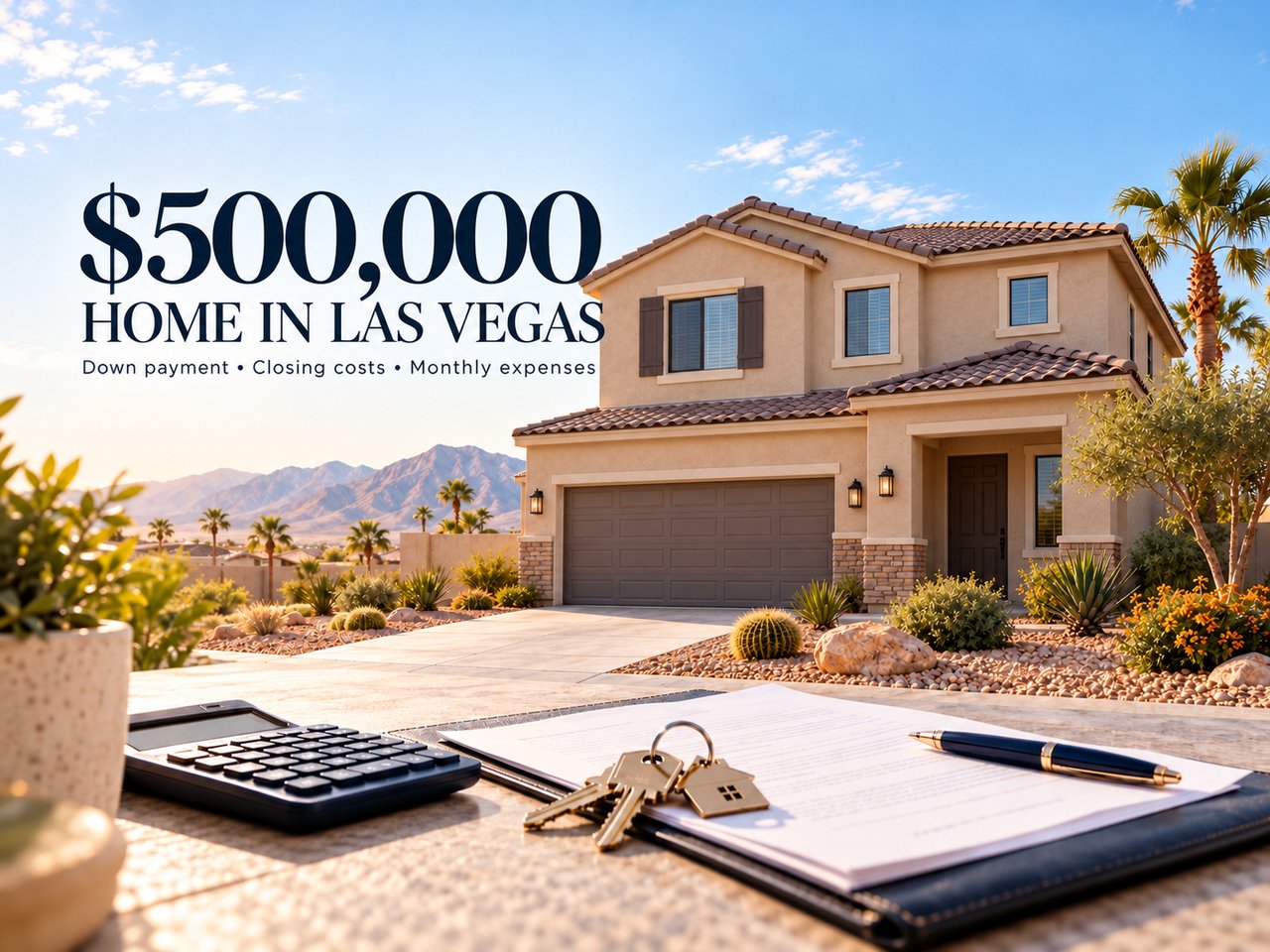
How Much Does It Cost to Buy a $500,000 Home in Las Vegas?
What does a $500,000 home cost? The short answer
Plan on roughly $27,000 to $120,000 for your down payment and closing costs, before deposits and credits, and about $3,800 to $4,900 a month including a maintenance reserve. These estimates assume a 30-year fixed mortgage at 7.32%. Monthly figures exclude HOA dues and utilities; your actual rate and property expenses will vary. The price tag is only the starting point; closing costs, mortgage insurance, property taxes, insurance and upkeep decide what the home really costs you.
The estimates below use one $500,000 home and four down payment scenarios: 3.5% (FHA), 5% and 10% (conventional with private mortgage insurance) and 20% (conventional, no mortgage insurance). They are planning numbers built from published averages as of late October 2026, not a quote. Your lender's Loan Estimate and the specific parcel's tax record will replace them. Whether you are looking in Las Vegas, Henderson or Summerlin, the same framework applies; only the tax rate, HOA dues and the home itself change.
Plan your upfront funds
Budget roughly $27,000–$120,000 for the down payment and closing costs, before deposits and credits. Keep a separate reserve for moving and unexpected expenses.
Plan your monthly budget
Budget roughly $3,800–$4,900 at the assumed 7.32% rate, including maintenance. Add the specific home’s HOA dues and utilities.
Key Takeaways
- Your down payment changes both budgets. Less down preserves cash but generally increases the monthly payment.
- Cash to close is the remaining amount due. Deposits, credits and adjustments change what you bring to closing.
- The monthly budget includes maintenance. HOA dues and utilities are additional.
- Property-specific figures matter. Replace estimates with lender quotes, parcel tax records, insurance quotes and HOA documents.
$500,000 home costs at a glance
Consideration | 3.5% down (FHA) | 5% down | 10% down | 20% down |
|---|---|---|---|---|
Down payment | $17,500 | $25,000 | $50,000 | $100,000 |
Loan amount | $490,944 (includes $8,444 upfront MIP) | $475,000 | $450,000 | $400,000 |
Est. closing costs (2–5% of base loan) | $9,650–$24,125 | $9,500–$23,750 | $9,000–$22,500 | $8,000–$20,000 |
Down payment + closing costs (before deposits/credits) | $27,150–$41,625 | $34,500–$48,750 | $59,000–$72,500 | $108,000–$120,000 |
Principal and interest (7.32%, 30-yr) | $3,372 | $3,263 | $3,091 | $2,748 |
Mortgage insurance | $221 (FHA annual MIP) | $182–$594 (PMI) | $172–$562 (PMI) | $0 |
Property tax (illustrative allowance) | $430 | $430 | $430 | $430 |
Homeowners insurance | $183 | $183 | $183 | $183 |
Payment to lender (PITI + MI) | ≈ $4,206 | $4,058–$4,469 | $3,876–$4,266 | ≈ $3,360 |
Maintenance reserve (1%/yr) | $417 | $417 | $417 | $417 |
Monthly budget (excludes HOA/utilities) | ≈ $4,623 | $4,474–$4,886 | $4,293–$4,683 | ≈ $3,777 |
The rate assumption is Freddie Mac’s national average for a 30-year fixed loan, 7.32% for the week of October 22, 2026 [1]. That survey reflects conventional loans with 20% down and strong credit, so FHA and low-down-payment quotes can come in higher or lower. FHA figures use the 1.75% upfront premium and 0.55% annual premium that apply to most 30-year FHA loans with less than 5% down [2], and the $482,500 base loan must be checked against the applicable county and property-type limit using HUD’s mortgage limit lookup [3]. PMI is shown as Bankrate’s typical range of 0.46% to 1.50% of the loan per year [4]. Property tax uses an illustrative $430 monthly allowance, not a verified bill or a countywide tax rate; replace it with the specific parcel’s tax estimate [8], insurance uses NerdWallet’s Las Vegas average of about $2,190 a year for $500,000 of dwelling coverage [9], and maintenance uses the low end of the 1% to 4% rule of thumb [10]. These figures come from different sources and methods, so treat them as a budgeting frame, not like-for-like data.
How much cash do you need at closing?
The table shows your estimated down payment plus closing costs before deposits and credits. Your remaining cash to close subtracts earnest money already deposited, applicable seller or lender credits, and costs already paid, with adjustments for prorations and other items on your Closing Disclosure [11]. Earnest money is part of your purchase funds, not an additional down payment. Down payment is the big swing: $17,500 at 3.5% versus $100,000 at 20%. Closing costs, by contrast, stay in a similar range across every scenario, roughly $8,000 to $24,000, because most of them track the loan and the home rather than your down payment.
Plan for the timing of upfront payments as well as the total. An appraisal paid before closing can still be a closing cost; avoid counting it twice when reviewing the final disclosure. Budget separately for inspections where not already included, moving costs, and an emergency reserve after you get the keys. Lenders may also ask to see reserves in your account, so confirm their requirement early.
What closing costs should Las Vegas buyers expect?
Buyer closing costs typically run 2% to 5% of the loan amount nationally [5]. Common line items include the lender’s origination fee (often 0.5% to 1% of the loan), the appraisal, title insurance, escrow and recording fees, per-diem interest from closing to your first payment, and prepaid items such as the first year of homeowners insurance and a starting balance for your tax and insurance escrow account [5]. The table uses this broad planning range rather than a statewide average with potentially different inclusions. Your Loan Estimate should separate loan fees, prepaid expenses and initial escrow funding so you can compare offers consistently.
One Nevada-specific item to watch is the real property transfer tax. In Clark County it is $2.55 for every $500 of value [6], or about $2,550 on a $500,000 sale. State law makes buyer and seller jointly liable, and who pays is negotiable, so your purchase contract should spell it out [7]. On a resale, also ask about HOA transfer and resale-package fees if the home is in an association.
How does mortgage insurance change the monthly cost?
With less than 20% down, you pay for insurance that protects the lender. On this home, that adds roughly $170 to $600 a month depending on loan type, down payment and credit.
FHA: the 1.75% upfront premium is usually rolled into the loan, and with less than 5% down the 0.55% annual premium lasts for the life of the loan [2]. With 10% or more down on an FHA loan, the annual premium ends after 11 years [2]. Many FHA borrowers later refinance to remove it, which depends on rates and equity at that time.
Conventional PMI: you can ask your servicer to cancel it once your balance reaches 80% of the original value, and it ends automatically at 78% if you are current on payments [4]. Credit score drives the price, so getting a PMI quote at your actual score matters more than any average.
How should you estimate property taxes and insurance?
Nevada property taxes use the Assessor’s taxable value, rather than simply the purchase price. Assessed value is 35% of taxable value; the applicable tax-district rate and any eligible abatement determine the bill [8]. The table’s $430 monthly allowance is an illustration, not a verified rate, maximum or prediction for your home. Check the parcel’s tax district, current bill and abatement status before relying on a monthly estimate. Start with the Clark County Assessor’s property search and follow the parcel’s Treasurer information for its tax bill.
For insurance, the cited Las Vegas estimate of about $2,190 a year assumes $500,000 in dwelling coverage [9]. That coverage amount is not necessarily the right amount for a $500,000 purchase: insurance should reflect the home’s estimated rebuilding cost, not its sale price. Roof age, construction, deductible, claims history and credit can all move your quote, so ask for one while you are under contract rather than after.
How much should you budget for maintenance, HOA dues and utilities?
A common rule of thumb is to set aside 1% to 4% of the home’s value each year for maintenance and repairs, leaning toward the low end for newer homes and higher for homes more than 30 years old [10]. On a $500,000 home that is $5,000 to $20,000 a year. We used 1% ($417 a month) in the table; if the home has an older roof, original HVAC system or an aging pool, budget more. In the desert climate, HVAC service, roof and stucco upkeep, irrigation and pool equipment are worth pricing out during your inspection period.
The table leaves out two costs that vary too much to average: HOA dues and utilities. HOA dues in the valley range from none to several hundred dollars a month, and some communities also carry special assessments or a separate master association. Ask for the HOA budget, reserve study and fee schedule, and ask the seller for recent utility bills so you can add both to your monthly number.
How huntington & ellis would plan a $500,000 purchase
We start with the monthly number you are comfortable with, not the maximum a lender approves. From there we work backward: get Loan Estimates from more than one lender at your actual credit score, compare FHA and conventional side by side, and look at how much cash you want to keep in reserve after closing. When we find a home, we pull the parcel’s tax history, the HOA documents and the inspection findings so the monthly estimate reflects that specific property. In negotiation, seller credits toward closing costs or a rate buydown can sometimes do more for your monthly cost than a lower price. Our buyer services walk through each of these steps.
When you are ready for a Loan Estimate, our preferred mortgage lender is note. A Mortgage Agency (NMLS #2413481). Their loan officers can price the loan options you qualify for on the same home so you can compare down payment scenarios like the ones above with real numbers. You are always free to choose any lender, and comparing more than one quote is a smart move whoever you work with. Our preferred partners page lists note. and other professionals you can contact.
Which down payment should you plan around?
There is no single right answer. A smaller down payment gets you into a home with less cash and keeps more in reserve, but costs more each month and for longer. A larger one lowers the payment and removes mortgage insurance, but ties up savings. A useful test: in our example, moving from 5% to 20% down saves roughly $700 to $1,100 a month but takes about $70,000 more cash. Ask yourself whether that cash would be better used as a down payment or as a cash cushion, and run both through a lender. Rates matter too: on a $475,000 loan, every one percentage point change in rate moves principal and interest by about $317 a month.
Frequently Asked Questions
What is the monthly payment with 20% down?
With $100,000 down and a $400,000 loan at 7.32% over 30 years, principal and interest are about $2,748 a month. Using this article’s tax and insurance allowances brings the payment to about $3,360. Adding a $417 maintenance reserve brings the monthly budget to about $3,777, before HOA dues and utilities.
Is earnest money an additional cost?
Earnest money is generally credited toward the funds you owe at closing. It reduces your remaining cash to close rather than adding to the down payment and closing-cost total. Your contract determines how the deposit is handled if the purchase does not close [11].
Do you need 20% down to buy in Las Vegas?
No. The examples here include 3.5% down with FHA and 5% or 10% down with conventional financing, subject to qualification. A 20% down payment avoids conventional PMI, but the right choice depends on your payment, eligibility and the savings you want to retain after closing.
How much income do you need to buy a $500,000 home?
There is no single qualifying income. Lenders consider the housing payment, recurring debts, income, credit and loan program. For a personal budgeting illustration, allocating 30% of gross income to the estimated $3,360 housing payment in the 20%-down scenario implies about $134,400 in annual gross income. That percentage is not an approval rule, and this example excludes HOA dues, utilities, maintenance and other debts. Ask a lender to calculate your actual debt-to-income ratio and qualification.
Run the numbers on a real home
Tell us your price range and down payment and we will help you build a total monthly cost for specific listings, from tax records to HOA documents. Search current listings, talk with our team or connect with a loan officer at note. A Mortgage Agency for a personalized quote.
About the Author
huntington & ellis, A Real Estate Agency serves buyers and sellers across the Las Vegas Valley, including Henderson, Summerlin and North Las Vegas. Our team helps buyers compare homes, understand property-specific expenses and coordinate with lending professionals.
Sources & Methodology
- Freddie Mac, Primary Mortgage Market Survey (30-year fixed 7.32% and 15-year 6.68%, week of October 22, 2026; national averages, not a quote).
- HUD Mortgagee Letter 2023-05 and Bankrate, FHA mortgage insurance (1.75% upfront MIP; 0.55% annual MIP above 95% LTV; 11-year duration at 10%+ down).
- HUD, FHA Mortgage Limits (select Nevada, Clark County, the applicable year and property type; confirm the limit with your lender).
- Bankrate, Private mortgage insurance basics (0.46%–1.50% annual range; 80% request and 78% automatic termination).
- Bankrate, What are closing costs? (2%–5% of loan; typical items).
- Clark County Recorder, Declaration of Value packet (transfer tax of $2.55 per $500).
- Nevada Legislature, NRS 375.030 (buyer/seller liability and contractual allocation of transfer tax).
- Clark County Assessor, Real Property (taxable value, 35% assessment ratio, tax districts and abatements). The $430 monthly allowance in this article is illustrative.
- NerdWallet, Home insurance in Nevada (Las Vegas average about $2,190/year for $500,000 dwelling coverage; updated March 2026).
- Fannie Mae, How to build your maintenance and repair budget (1%–4% of home value per year).
- Consumer Financial Protection Bureau, Loan Estimate explainer and Closing Disclosure explainer (deposits, credits, prepaid costs and cash to close).
Editorial notes: all scenarios assume a $500,000 purchase, a 30-year fixed loan at 7.32%, the same rate across loan types, and first-year mortgage insurance. Closing costs are calculated on the base loan amount. Payments are rounded; totals calculated before rounding may differ slightly from the sum of displayed components. The tax allowance is illustrative. No personalized lender quote or property-specific tax or insurance assessment is implied. HOA dues, utilities and seller or lender credits are excluded.