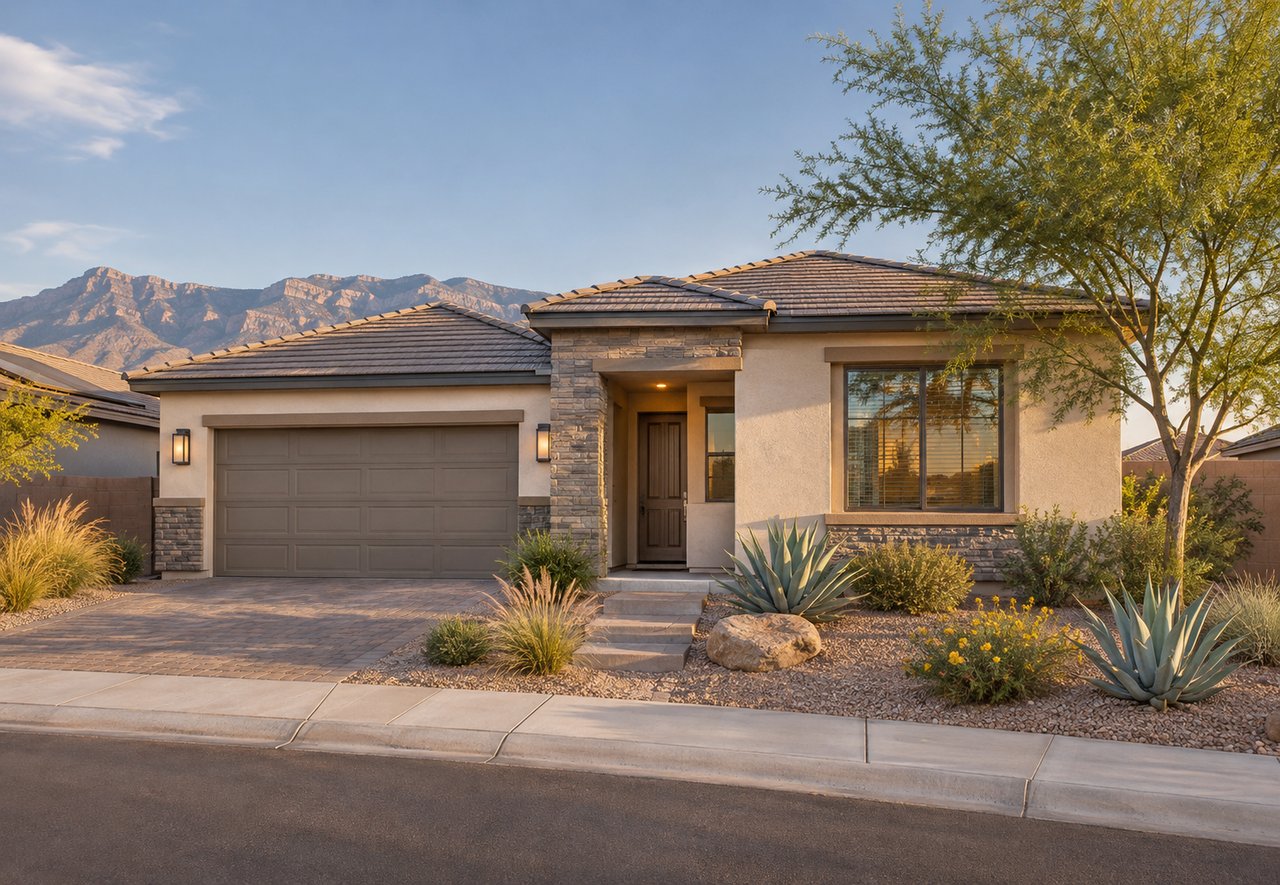
Condo vs. Townhome vs. Single-Family Home in Las Vegas
Quick answer: In Las Vegas, condos generally offer a lower purchase price and less exterior maintenance. Townhomes can provide more space, but ownership and HOA responsibilities vary. Single-family homes usually offer more control over the property and more maintenance responsibility.
The best fit depends on the complete monthly budget, the repairs you want to manage and the financing available for the specific home. A lower listing price does not always mean lower ownership costs once association fees, insurance and future repairs are included.
Use the comparison below to narrow your search, then review actual homes in the Las Vegas communities you are considering.
What is the difference between a condo, townhome and house?
A condo is a form of ownership; a townhome describes a building style. A townhome can be legally organized as a condominium or as a home on its own lot in a planned community. That distinction affects maintenance, insurance and the lender’s review.
Consideration | Condo | Townhome | Single-family home |
|---|---|---|---|
What you typically own | A defined unit plus a shared interest in common elements | The lot and structure, or a condominium unit, depending on legal setup | The lot and structure; some detached homes are legally condos |
Exterior maintenance | Often handled by the association, subject to governing documents | May be covered by the HOA or assigned to the owner | Usually the owner’s responsibility |
HOA fees | Often fund shared building expenses and amenities | Depend on exterior coverage, shared property and amenities | May fund common areas; some homes have no HOA |
Insurance | Unit-owner coverage coordinated with the master policy | Coverage depends on ownership and the association’s policy | Usually a policy covering the dwelling and other selected risks |
Financing | Project eligibility can affect loan approval | Condo or planned-community requirements depend on legal classification | Usually less project-review work, depending on legal setup and loan program |
In a planned unit development (PUD), buyers generally own their individual lot and home while an association manages shared property. The community’s declaration, title documents and recorded maps establish the actual arrangement.
Ask for the covenants, conditions and restrictions (CC&Rs)—the recorded community rules—and the preliminary title report. The MLS label alone does not establish what you own or which repairs you must pay for. Nevada’s condominium definitions and unit-boundary provisions appear in NRS Chapter 116 .
How do monthly ownership costs compare in Las Vegas?
Compare the mortgage, property taxes, insurance, every association fee and a repair reserve. The examples below show how those expenses can combine at three different purchase prices.
Illustrative scenarios: These are hypothetical budgets, not listings, local medians or insurance quotes. Each uses 20% down and a 30-year fixed loan at an assumed 7% interest rate. Taxes, insurance, HOA fees and repair reserves are planning assumptions. The rate is not a current lender offer; no APR is calculated because loan fees are not modeled.
Budget item | Condo example | Townhome example | House example |
|---|---|---|---|
Purchase price | $225,000 | $343,000 | $485,000 |
Down payment: 20% | $45,000 | $68,600 | $97,000 |
Loan amount | $180,000 | $274,400 | $388,000 |
Monthly principal and interest | $1,198 | $1,826 | $2,581 |
Property tax allowance | $122 | $186 | $263 |
Insurance allowance | $50 | $80 | $185 |
HOA fee assumption | $300 | $230 | $100 |
Monthly repair savings | $100 | $215 | $405 |
Illustrative monthly budget | $1,770 | $2,537 | $3,534 |
Principal and interest are rounded to the nearest dollar before totals are added. The tax allowance uses 0.65% of the purchase price annually solely for illustration; it is not a Nevada tax calculation. Use the property’s actual bill and confirm any expected changes. Utilities, closing costs, moving expenses, mortgage insurance and special assessments are excluded.
The condo has the smallest budget in these examples, largely because it has the lowest purchase price. The table does not isolate the effect of property type. For your decision, compare homes in a similar price range and replace each assumption with property-specific figures.
Repair savings are money you set aside, not a fixed monthly bill. Even when an HOA maintains the exterior, owners can face interior repairs, insurance deductibles or special assessments. A lower down payment may also change the loan terms and add mortgage insurance.
What should you check about HOA fees?
Compare what the dues pay for and whether the association can fund future repairs. A higher fee may include building insurance, roof maintenance or utilities that another community charges separately.
- Included services: Confirm exterior repairs, landscaping, amenities, water, sewer and trash individually.
- All association charges: Check for both master-community and neighborhood dues, plus pending assessments.
- Reserves: Review savings for major shared repairs and the reserve study, which estimates future replacement needs.
- Insurance: Ask which building components the master policy covers and which deductibles or gaps could fall to you.
- Rules: Read parking, pet, rental and exterior-modification restrictions before committing.
A special assessment is an additional charge to owners, often used for expenses that regular dues and existing reserves cannot cover. Ask about approved assessments, proposed projects and recent board discussions.
What is Nevada’s resale-package review period?
Under NRS 116.4109 , a buyer covered by the resale-package provisions may cancel by written notice until midnight of the fifth calendar day following receipt of the package. Follow the statute’s notice requirements and review the deadline with your agent.
The association must furnish specified documents and a certificate for the package within 10 calendar days after receiving a written request from the owner or authorized agent. Review the governing documents, budget, financial information and insurance materials; request the full reserve study and recent board minutes as well.
Is financing a condo different from financing a house?
Yes. For a condo, lenders may need to evaluate the association and project as well as your finances and the individual unit. A borrower preapproval does not establish that a particular condo qualifies for the loan.
For conventional loans sold to Fannie Mae, the available review route depends on the project and transaction. Some qualify through an existing approval or a project-review waiver; others require a Full Review or another applicable review process. Financial condition, insurance and needed repairs can affect eligibility. See Fannie Mae’s condo and property insurance FAQs .
Reserve funding is one part of that assessment. Fannie Mae’s Full Review guidance includes a budget-allocation test and a qualifying reserve-study alternative. Have the lender confirm the requirements and effective dates that apply to your loan.
For FHA financing, a condo generally needs an approved project or an eligible Single-Unit Approval, which allows a qualifying individual unit in certain unapproved projects to be considered. Eligibility is subject to HUD and lender requirements; see HUD’s condominium guidance .
With a townhome, establish whether it is legally a condo or a home in a planned community before comparing loan options. Ask your lender: “Does this property qualify for my program, what documents are needed, and could project review affect our closing timeline?”
Who handles repairs, insurance and maintenance?
Responsibility follows the governing documents and insurance policies. Shared walls do not automatically mean shared responsibility for every repair.
- Condo: The association often maintains shared roofs and exteriors, while owners handle interior components. Check windows, plumbing, balconies and air-conditioning equipment individually.
- Townhome: Some associations maintain roofs and exterior paint; others cover only shared landscaping or amenities.
- Single-family home: Owners usually maintain the roof, air-conditioning system, yard and structure, even when they pay HOA dues.
In Las Vegas, ask about the age, service history and condition of the air-conditioning system and roof. Obtain inspections and repair estimates for the particular home rather than relying on a broad replacement-cost range.
A condo owner often needs an HO-6 policy, a unit-owner insurance policy that can cover personal property, liability and portions of the unit. Coverage must fit the association’s master policy. Townhome insurance can resemble condo coverage or a full homeowners policy, depending on the legal setup and coverage responsibilities. Have an insurance professional identify gaps and applicable deductibles.
Frequently asked questions
Is a townhome legally a condo in Nevada?
It can be. “Townhome” describes a building style, while condominium ownership is a legal arrangement. Review the declaration, title documents and recorded maps to confirm whether you own a condominium unit or a home and lot in a planned community.
Are Las Vegas condos cheaper after HOA fees?
They can be, but the answer depends on the purchase price and the expenses included in the dues. Compare mortgage payments, taxes, insurance, all association charges and repair savings for the actual homes you are considering.
Who pays for a townhome’s roof?
The owner or association may be responsible, depending on the governing documents. Confirm roof maintenance, replacement and insurance responsibilities separately. HOA dues alone do not tell you which party pays.
Can I buy a Las Vegas condo with an FHA loan?
Potentially. The property generally must be in an FHA-approved project or qualify for Single-Unit Approval. Your lender must confirm both borrower and property eligibility under the applicable program requirements.
Does a single-family home always have lower HOA fees?
No. Dues depend on the community and services provided. Some detached homes have no association, while others have multiple associations or substantial amenity and maintenance charges. Confirm every fee for the property.
Compare homes with huntington & ellis
Tell us your budget, preferred areas and how much maintenance you want to handle. A huntington & ellis real estate professional can help you compare specific condos, townhomes and single-family homes, coordinate document review and work with your lender on the next steps.
Call 702-583-3030 to start your search.
Sources
- Nevada Revised Statutes, Chapter 116 : condominium ownership, unit boundaries and common-interest communities.
- NRS 116.4109 : resale packages and purchaser cancellation provisions.
- Fannie Mae: Condo and property insurance FAQs , November 2026.
- Fannie Mae Selling Guide: Full Review Process .
- HUD FHA Connection: Condominiums Help .
huntington & ellis, A Real Estate Agency · Equal Housing Opportunity. General information only; ownership responsibilities, financing eligibility, insurance and transaction deadlines must be confirmed for the specific property and transaction.